
+91-9830330809 / +91-9830050132

How to sort yourself out as a writer

It is pointless to sit and ponder on how to become a writer; anyone who writes is a writer. Now the question is whether one wants to take up writing as a profession, or as a part of life which shall work as a breather in stressful situations. If the answer is yes, one must identify which form of writing he is most comfortable with. Writing can be of various types, viz. copy writer, content writer, technical writer, communication writer, journalists, grant writer, poet, columnist, author, and it is important to identify in which field one is most comfortable. Thereafter set realistic goals and design the movement. If one plans to become a blogger, he needs to select a platform, set up the blog and start publishing. Likewise, if one aspires to become a copywriter, start listening to the lectures and podcasts of eminent copywriters and build a bridge with some of them. Next important thing is setting a routine.

For writing skills development, the foremost requirement is one must identify under which circumstances the writing is at its best. Some may be comfortable with tranquil surroundings while some may like to listen to music while writing. Similarly, some may find it comfortable to write in the morning while some in some other part of the day. Some may be comfortable writing sitting on the bed while some need a chair and table to write. Hence only the person can identify in which format he is at his creative best- and accordingly set up the routine of writing.

It is very important to write regularly as practice and perfection are co-related and hence developing writing habit is of extreme importance for anyone who aspire to become a writer. Ideally one should set a target of minimum numbers of words he shall write daily and accordingly write every day. Once this process is regularized, one shall start enjoying the writing job more interesting than ever- as with the development of expertise the writing shall become more free-flowing with smooth transition of thoughts to words. The next more important thing is reading as the more a person reads on a subject, the more quality he delivers through writing because of his newly acquired knowledge. For a beginner, it would be a better decision to write in simple words and with short sentences without excessive usage of adjectives.

Experiences enrich writing hence one needs to be an explorer looking around for variety and new experiences and keep a stalk of all the new experiences he acquires as in the long run, these would make the writing richer and more compelling. Nature and human behavior- both are amazing sources of experience with the variety and uniqueness in them. Ideally a writer may keep a journal where he would pen down interesting things he hears, interesting things he has met, interesting pictures- even interesting dreams which people forget very fast- all these shall contribute to writing later.

It is also important for a person to commit to himself about finishing the project if he aspires to be a writer. After writing till a certain time, one may tend to get lost and loose track. It is the determination that shall make a difference there and that shall drive one to finish the writing. And while writing, it is important to keep in mind whether the reader shall be interested in the writing. However, to glue the readers, one should not divulge from the area of core competence. One should write on areas where he has good command and not on topics which are difficult for him.

Giving a structure to the story from the time of conceptualization itself always helps an author in writing. Structure is chosen depending on the progression of the story and there are many structures that one can follow (like flashback etc.). However, it is always wiser decision for an aspirant writer to take the linear structure which is simpler with a beginning, a climax, and a resolution.


There is no thumb rule for the writer on how to start writing. If one waits for that moment, the waiting shall be futile as the golden moment shall never come. All one must do is to start writing. And what makes writing different is the experiences- not the opinions.

Writing is a process which starts with the invention stage. This helps the author in generating ideas for writing- whichever form he writes in. Questioning is a very good invention strategy which helps in testing a topic. One may use the questions ‘who, what, when, where, why and how’ to determine whether the topic thought of is worth writing about and if so, only then develop ideas on your topic. Next, one should write for ten minutes on the subject whatever comes to his mind- in a free-flowing way. This works as the plinth of the main writing and reading this later helps to add more ideas and content.

Understanding the target audience remains critical for any writer. Attention span varies among audience- a small kid can’t sit still for more than 10 minutes- so if writing for a kid, it has to be kept in mind that the content should be attractive enough to hold back the kid. At the same time, an adult gets bored with children story. J.K. Rowling or George Orwell are one in million who has attracted both set of audience with An Animal Farm or Harry Potter- so it is wise a new author doesn’t aspire to imitate them.  Appropriateness and targeting the right age is also important in order to understand the target audience. A book with lots of sex content cannot be considered for the kids. Again, Mills & Boons type novels are widely read by women- so a fantastic response from the young male folks should not be expected from a book of soft romantic genre. Building a persona helps an author in this regard as that helps him in understanding the need and desire of the audience and based on that, the author finds out their interests and how they spend their time. To develop this persona, one first has to establish the demographic status which shall include the age, gender, location, income, education, family, and interests. Based on that, the author may contemplate developing goals, fears, values and challenges to understand the need of the consumer. And ultimately, this would help in identifying the niche as well.

There are many writing style in literature. Narrative writing is almost a storytelling in written form which capture a journey from start to the end with a proper beginning, interval and ending. Descriptive writing provides each aspect of the event, person, or place in detail giving the reader a feeling as if the reader himself was present when the incident took place. Expository writing is written to teach the reader on some topic and they are not written for entertainment. Persuasive writings are written to convince and persuade the readers on any issue. Though creative writing, an author breaks free from the existing writing structures and surprise the readers by sharing a story in a new way. Objective writing is a formal way of writing with true facts and figures which acts as a support to the writing. Subjective writing is just the opposite of objective writing and does not bother on correctness and accuracy- instead portray the writer’s beliefs, preferences, perspectives, feelings, and opinions on things. Review writing is a style where one review things- which can be anything of reader’s entertainment. In poetic writing, the author uses rhyme, rhythm, and meter to convey a story or idea. Technical writing is a style adopted for writing on a special point that is factual and logical or about a scientific purpose. From all these, choosing a writing style is very important for any writer as it is nearly impossible to absorb all the writing styles that attract the readers. A writer need to identify his comfort lies with which style- in which style his communication is at its best.


While writing a book proposal, ideally it should start with a header which is the working title for the project along with the writer’s name and contact details. Thereafter a brief synopsis of the book is to be added on the proposal that describe the content of the book in a compelling way. A long description of the book is to be added which would explain the book more in detail and what makes the author the best person for writing on this topic. A chapter breakdown shall follow with few sentences describing what the author shall cover in that chapter.  Certain details about the author should be there in the proposal in a short biodata format with specific objective of linking it with the book. To clear the cloud in the mind of the publisher, it is wise to mention the target audience as well along with the market of the book.


Why Self-Publishing Writers Need a Style Sheet

Editors use Style Sheets as a guide for treatment of specific items in documents- like language preferences, Punctuation and capitalization, formatting and Layout. Nearly all business have a style guide and editing style sheet is something similar to style guide, but limited to writing only. Multinationals use style sheets for their internal as well as external communication materials; editors and writers use them when they work on manuscripts. The benefits of using style sheets is manifold. It helps in providing a consistency in regard to the writing encompassing spelling of certain items, abbreviations etc. style sheet helps in saving time as one doesn’t need to keep looking at things over and over repeatedly. And finally the financial aspect, as the editor can save time with help of style sheet and can use the saved time for another assignment.

Sometimes, the client specify the style using a style guide If a client specifies using a style guide which the editor or writer use as a reckoner when they come across any contentious stylistic issues. Sometimes, the client share provide an in-house style sheet which they operate in office to ensure standards and specifications are met. However, when they are not provided by the client, the editor creates one to ensure inconsistencies are identified easily and stylistic preferences are identified. These style sheet editing become extremely useful while proofreading a very long document where consistency is to be ensured across hundreds of pages. They are helpful while working regularly for one client as well when he want to ensure consistency across documents.

How to create a style sheet for editing

The purpose of a style sheet is ensuring consistency in a document or a set of documents and hence while creating a style sheet for editing, the following things must be covered:

Linguistic preferences: this shall cover the type of dialect (eg. Which type of English is to be used?) , whether the writing style be academic, formal or informal, spelling preferences, preferred terminology and vocabulary, abbreviations, acronyms that are to be used, the numbers are to be written in words or I numerical only, time and date format, etc.

Punctuation: the comma usage, use of hyphens and dashes, use of single and double quote marks, spacing of ellipses.

Formatting and layout: preferred font size and typeface, usage of bold, italics and underlines, heading and subheading styles, the way to begin new chapters or sections, page numbering style, margin orientation, usage of headers and footers, how to present the images and other non-textual things.

In regard to the linguistic preferences, with the writing style, few areas are to be considered as each writing style has separate specifications. Like for academic writing, information on the client’s chosen referencing style, technical terminologies used, labelling of figures, charts and tables are to be considered in the style sheet. Similarly, in case of fiction or non-fiction, character names and key details, geography of the location, timeline of events and major plot points, slangs and non-standard spellings in dialogues and the presentation of the speech and thoughts of the characters are to be considered.

When one knows what are to be included in the style sheet, ideally the sections are to be broken down for easy reference where each section shall have a clear heading and shall cover one aspect of the document’s style. This shall make the style sheet easier for usage of anyone.

Self-publishing is the way of publishing where the author publishes his own book at his own cost and the publisher is not involved in the process. This is not a new development in the publishing world as self-publishing has been happening for more than 200 years. However, in this age of digitalization, the authors have realized that if professionals are not used in this process of publishing a book, the entire effort of publishing would be futile as the product shall not be able to compete in the market. Hence there is a new set of companies (“Assisted Self-publishing Providers” /”Self-publishing Service Providers” and the like) that have emerged in the market whose focus is providing a wide array of services to the author from where he can select the services required for producing a high-quality book.  In self-publishing, the absence of gatekeepers like literary agents and publishers help in diversifying and providing a space to the author. The earning of an author in self-publishing is much more and often more than 5 times than in case of traditional publishing. And the biggest advantage is the fact that there is more control over the publishing process and decisions are taken by the authors only. Moreso, qualitatively there is no difference between self-publishing and traditional publishing.


Branding has been defined by American Marketing Association saying brand is a name, term, design, symbol, or any other feature that identifies one seller’s good or service as distinct from those of other sellers- hence one may consider a brand as the idea or image people have in mind when thinking about specific products, services, and activities of a company. A product can be easily copied by other players in a market, but a brand will always be unique.  A typical example is Pepsi and Coca-Cola- both tastes very similar, however for some reason, some people feel more connected to Coca-Cola, others to Pepsi. To build a brand, a marketing team follow a four-fold step.  First, the marketing team must determine the target audience. Here, fist one must determine the prospective buyers. Thereafter sue the available statistics and data of the prospective buyers, check on the strategy the other companies have taken to reach out to them and finally reach out to the prospective buyers to speak to them. Based on the feedback received from the prospective buyers, the product shall be positioned. Defining the company personality is the next step in building a brand and finally a logo or slogan is chosen based on the legworks mentioned earlier.  For a publisher, it is the author who is a brand, and they expect the association of the authors and their types to reflect the mission of the publishing house as a whole and distinguishes it from the competition. However, publishing brands are not on the mind of the readers, and they are only concerned on whether the book is good or a must-have. But most books or eBooks are sold through channel partners such as bookstores and wholesalers who service them and it is the stores that provide access to the consumer. This is where brand loyalty plays a pivotal role as it has a direct impact on profitability.


Proofreading is the process of checking a final draft with utmost care and correcting the typographical mistakes, grammatical mistakes and other issues pertaining to writing before finally the book goes for print. This is the last step of writing and is concerned mostly with the mechanical aspects of writing. Proofreading is the process of carefully checking for errors in a text before the author’s book is published or shared. This is the last stage of writing the book and in this stage, minor spelling and punctuation mistakes, typos, formatting issues and inconsistencies are corrected. Proofreading is extremely important for any book that is supposed to be shared with the readers, whether it’s an academic paper, a job application, an online article, or a print flyer. Based on the skills and budget, one chooses to proofread the text yourself or to hire a professional.

Economics of Self-Publishing Book

The economy of self-publishing fully depend on whom you are hiring and how much you can spend. It depend on your need and whether you are hiring the right persons on the job. In order to self-publish you need to have a team helping you with the cover design, editing, formatting, marketing strategy, and project management. Having a solid team of experts will ensure that you have a successful book launch and book sales. There are also marketing costs like creating and designing a website, promoting your book on social media, and purchasing promotional materials. The most important advantage in self-publishing is that you make 100% of the profit for each book that you sell directly. The price can be adjusted based on the printing cost and how many books you are selling directly to someone or a company.

A survey done in US 10 years back revealed the average self-published author earns $10,000 a year. And even that paltry sum is escalated by the successful writers in self-publishing economy, 10% of the authors in the study made 75% of the money. 75% of authors made under $500.

How much does cost to publish book

There was a study done in Australia in regard to economics of self-publishing book few years back. As a case-study, the cost was calculated on a 200 page non-fiction book with 30,000 word-count. An average rate of 500 words per hour is something which is manageable for writing a non-fiction, and that which would equate to 60 hours. Adding the planning and research time involved for writing, the time was doubled to 120 hours. And thereafter a calculation was made on how much a person can earn by spending 120 hours of real time. Copyediting of a 30,000 word manuscript will cost in the range $150 to $1000. Typesetting of our text-heavy book will cost in the range $250 to $1500. Cover design cost shall range between $400 and $1500. ISBN for the paper book and another one for the e-book version shall be needed for publishing. The cost in Australia is $44 for one. Considering a minimum order of at least 200 copies, and preferably 500 or 1000, and for the purpose of keeping the unit price as reasonable as possible, the cost shall be something less than $7. Adding the handling fee and shipping charges, the cost of one copy shall be around $12.50.

Book publishing budget

You should design your book covers so they are clear and readable across numerous devices, whether the book is displayed as a thumbnail, full size, low- or high-resolution, colour or grayscale. The formatting depends on the services used but most services offer tools to help convert books into the correct format.

If you are not confident about doing this process alone, self-publishing service companies are there to help you with the hard work with a cost. They shall offer various services including proofreading, editing and illustrations and also help on the marketing and retail side. They’ll automatically advertise the book on their own websites as well as with affiliates, which are usually large, well-known companies.

For those offering print books as well as e-books, there are two options to consider: print-on-demand (POD) and traditional offset printing. It is advisable you reduce any financial risk with POD technology. This service prints one copy at a time. The book is distributed through book wholesalers as well as online retail outlets. The downside is a higher retail price is charged as the cost of each unit is higher to produce than with traditional offset printing.

In case of offset printing, the cost is lower and higher in quality than POD- though you have to commit a minimum number of published units here.

Book publishing cost 

There has been an explosion of digital books through Amazon and other platforms like iBook, Wattpad and Kobo. First time authors have finally got a chance to showcase their talents. A rough cost of self-publishing may help the aspiring authors in the long run.

For a 250 page book 225/- to 249/- is an ideal price (particularly for new authors), a printing press will take anywhere about 60/- to 120/- per book. In case you are ordering in bulk publishing of 200 book, the cost may be somewhere between 12,000/- and 24,000/-(Average 18,000/-).Amazon costs 13% of MRP for each print book sale and they offer pick and delivery service too which may cost another 10% of MRP. Still if you sold the book online you’ll get a good amount of money for the deal as recent reports suggest 50% of books are purchased online in India. In case if you are calculating everything, you’ll spend about 50% (for printing) another 25% (amazon share and delivery) and another 10% in marketing. Total 50%+25%+10%= 85%-100%=15% is your royalty which is double than that from the traditional publishers. Hence, if your book’s MRP is 249/-, then you will save about 37/- over each book sale. It’ll be better if you spend a bit more and try to give few free copies to other authors of your genre, if they read and review/commend it then it’ll be a great marketing success for you. Also search for few best book distributors and retail chains, fix a meeting with them and give a presentation of your book to them. They may show interest in your book. Try to offer few free test copies to them. Amish Tripathi had self-published his first book “Immortals of Meluha” after getting rejected by 20 publishers. But later when the book succeeded, they all came back to him. If your book succeeds and if a big publisher shows interest in it then you may relaunch it too.

Every print book needs an ISBN no. you can get one online through isbn.gov.in, it’s free. Always confirm with your printing press whether they shall provide barcoding of your ISBN or not. In case they don’t, the press can be asked for options- they being the publishers, have knowledge about it. If you don’t have money, try to raise it through a fundraising campaign. You may offer your donors a print copy of your book if they support you more than the MRP cost of your book. It shall be a great way to promote your book too, and you can use your books or your imprint’s facebook page for that. As far as the digital or e-book is concerned, you can publish it on kindle for free.

Depending on the amount of money an author spends on editing, cover design, formatting, and other services, publishing a book may cost them anywhere between 45,000/- to 90,000/- (exclusive of 18% GST) in India. Book formatting cost ranges between 10,000/- and 15,000/-. Book editing cost range between 25,000/- and 28,000/-. Book editing cost range between 25,000/- and 30,000/-. Book editing cost ranges between 40,000/- and 45,000/-. All these costs vary depending on the number of pages, the size of the book, the thickness of the paper, and other factors.

Self-publishing

In self-publishing, authors publish their own book instead of spending time in convincing and coaxing the traditional publishers. In self-publishing, many a times we see the author himself is single-handedly carrying out the whole process. However with the increase of awareness on the benefits of self-publishing, more and more authors are realizing that to compete effectively, they need to produce a high quality product, and they are engaging professionals for specific services as needed (such as editors or cover designers). There are no gatekeepers in self-publishing and no literary agents or publishers standing in your way. This allows for diversity to flourish and for underrepresented voices to finally have a space to share their work. Margins are much higher in this mode. And in this mode, the access to improved technology and distribution mode is as much as in case of traditional publishing. In this mode, the author has the freedom to decide on What type of editing the book deserve, the book type and format, book cover and interior design, Where the book shall be distributed and how the book is promoted.

Publishing industry

Publishing is the activity of making information, literature, music, software and other content available to the public for sale or for free. The industry that runs the publishing is the publishing industry. This publishing industry involves production and dissemination processes to make information, such as literature, music, software, and travel aids, available. Earlier it was confined to printed works—traditional books, newspapers, and magazines. However, with the advent of digital information, the book industry now publishes in blog, e-book, Web site, and other electronic formats.  The industry employs a diverse workforce to assist in the many stages of publishing.

  • Writers, researchers, and editors develop and refine copy;
  • Artists and graphic designer position text & images for readability on the page and on  screen;
  • Press and production operators produce physical documents;
  • Digital designers and developers prepare electronic publications;
  • Sales and marketing forces disseminate and distribute the products.

Marketing and promotion

Book marketing creates awareness for a specific book among booksellers and consumers. The goal of marketing, of course, is to generate book sales.

The best formula for promotion of books as described by the champions of book marketing are as follows:

  1. Create an Eye-catching Cover
  2. Write a Great Description
  3. Take a Great Author Photo
  4. Gather Blurbs for Your Book
  5. Set up Your Author Website
  6. Create an Author Central Page
  7. Create a Goodreads Author Page
  8. Add the Book to Your Email Footer
  9. Contact Media, Bloggers & Influencers
  10. Write Guest Posts and Articles
  11. Go on Podcasts
  12. Gather Book Reviews on Amazon
  13. Use Your Email List
  14. Use Your Social Media Presence
  15. Write LinkedIn Articles
  16. Give It to Clients (And Potential Clients!)
  17. Start a Blog or Podcast
  18. Create an Audiobook
  19. Use Book Promotion Sites

Revenue and profits

It’s a fairly common arrangement for the retailer to get about half of a book’s sale price, plus or minus a non-trivial range of variation depending on a number of factors. These days, it’s also common to use a distribution network for warehousing and shipping, and they get a slice of several percent. Assuming the author is being paid on a royalty basis instead of work for hire, they get around 10%, again plus or minus several percent depending on a variety of conditions; back when I was in publishing, I saw as low as 8% and as high as 15% for various authors. The publisher gets what’s left, so it’s not uncommon for a publisher to get anywhere within a range of, say, 30% to 50%.

The percentage of revenue that goes to publishers and authors can vary depending on the book, the publisher, and the specific contract between the author and the publisher. In general, traditional publishers will typically take a higher percentage of the revenue than self-publishing platforms, where authors retain more control over the distribution and pricing of their books. In a typical traditional publishing deal, the publisher will take around 15-25% of the revenue from book sales, with the remainder going to the author. This percentage can be higher or lower depending on the specific terms of the contract. Self-publishing platforms, such as Amazon Kindle Direct Publishing, will typically take a smaller percentage of the revenue, around 30-40%. This allows authors to retain a larger percentage of the revenue from book sales. It’s also worth noting that these percentages can vary depending on the format of the book.

Distribution and sales channels

Book distribution channels are all the ways a book is sold and distributed to readers. These channels can include physical bookstores, online bookstores, wholesalers, distributors, and more.

The sales channel of books are

  • Direct Sales
  • Big Box Stores
  • Independent Book Stores
  • Libraries
  • Online Retail
  • Local Stores
  • Author Events

Royalties and advances

An advance is a signing bonus that’s negotiated and paid to the author before the book is published. It’s paid against future royalty earnings, which means that for every rupee you receive in an advance, you must earn a rupee from book sales before you start receiving any additional royalty payments. The advance is adjusted with future royalty payments once the book is on sale.

A book royalty is the amount that a publisher pays an author in exchange for the rights to publish their book. Royalties are calculated as a percentage of book sales. For example, an author might earn 7.5% royalties on every paperback sold and 25% on every eBook sold.

Royalties are prevalent and applicable typical in traditional publishing, where authors sell the rights to their book to a publisher. In self- publishing, royalties don’t exist because the author himself sets the prices and decides on the profit margin- he being the monarch of his empire and creation.

Writer vs. Author

A writer is a person who is engaged in the process of writing. If the person spends his days writing books, novellas, or short stories and writing has become a part and parcel of his daily routine. A writer need not have to write their own original ideas- a journalist, ghostwriter, blogger, or screenwriter can also be a writer where  subject matter and central idea of the writing comes come from someone else and irrespective of whether the idea or work shall get published.

Parameters Author Writer
Meaning An author is a person who is the originator of a written work like an article, a book. A writer is a person who writes a piece of literature, articles, blogs, novels, or short stories not necessarily on his ideas.
Required Skills A person becomes an author once their work gets published. There are no additional skills required to be another apart from having basic writing skills. A writer requires certain domain-specific skills or degrees.
Nature of Work An author develops plots and ideas and narrates them in the form of stories or plays. The writings of an author are lengthier in nature. A writer writes on specific topics that are brief and precise.
Publishing and Copyright An author’s books are always published with their name and the Which has the copyright of the author. The works of a writer are not necessarily published under their name.


Writer or Author: What’s the difference?

An author’ is the person one who originally creates his own content, whereas a ‘writer’ is the one who writes any sort of content concerned to the topic that has been assigned. An author develops and brings content into existence. The word author normally refers to all those people who write books, stories, articles, etc. professionally. On the other hand, a writer structures the ideas properly and presents them in the form of writing. They are known for their techniques of presentation and explanation and normally they write in magazines, articles, informative content, etc. Writers are not bound by the category and type of the content and their articles are from the future point of view.

Writer versus author: Which one are you?

A writer is a universal set, and an author is a subset to that. All authors are writers, but all writers are not authors. Anyone who writes is a writer- hence someone who is writing a journal is also a writer. But an author is essentially the person who originates the idea, plot, or content of the work being written and writes the book. To be an author, the idea of the writing must be of his own and he must get his work published. An author must have a specific skill set but writer’s skill is suited to the job required.  One may become an author when your books are published, but if his writings are never published, he remains a writer. An author normally get is work copyrighted.

What Is an Author

The author is a certain functional principle by which, in our culture, one limits, excludes, and chooses. The author is therefore the ideological by which one marks the way we fear the proliferation of meaning.

What Is a Writer

A writer is a person who communicates his ideas through his written words. Writers keep producing various genre of literary art and creative writing like novels, short stories, poetry, plays, news articles, screenplays, or essays. Writers who are skilled uses his language to express ideas and their work contributes significantly to the cultural content of a society. Writers can produce material across a few genres, fictional or non-fictional. Other writers use multiple media – for example, graphics or illustration – to enhance the communication of their ideas. Some use images or multimedia to augment their writing. In some cases, a creative writer can communicate their ideas via music as well as words.  Writers can be professional or amateur, that is, for payment or without payment and may be paid either in advance, or only after their work is published. Payment is the main motivation of some writers while many are never paid for their work.

Learn More About Writing

Writing is one of the most important skills a person can develop. It helps in communicating with other people and express the thoughts clearly. Many perceive writing is easy, but, it is extremely challenging at times- particularly when one is coming up with ideas for different types of writing projects. Writing skills are the skills you use to write effectively and succinctly. A good writer is someone who can communicate their point to their audience without using too much fluff and in a way that the other person can understand. Writing skills don’t just include the physical act of writing. Skills like research, planning and outlining, editing, revising, spelling and grammar, and organization are critical components of the writing process. Few areas which aways should be taken into consideration to improve the writing skills. First and foremost is grammar and spelling as they form the foundation of good writing- Even if a text is grammatically correct, one may be able to make it more dynamic and interesting with some polish by choosing strong verbs or shredding unnecessary words.  There is no substation of good reading- read as much as possible as the knowledge acquired from reading add value to the quality of the writing. If one is trying to write a humorous short story, read humorous short stories. If you are planning to write a book review, make sure to find a few and take note of how they’re structured. No matter how much one is tempted to submit the work after completion, it is important to remember the work is not complete unless a thorough check is done by revisiting what one has written to catch errors big and small. Feedback improves the quality and add value to the content- hence asking for feedback is a great way to see how a somebody besides the writer interprets the text. Structure ensures the big ideas get across to the reader and in many cases, forming an outline will help solidify structure.

Traditional publishing

Traditional publishing is the system where the book is published by an established publishing house and there shall be a team of professional people to take care of the book design, sales, marketing, and various other processes related to publishing of books. This is a more formal approach for the author’s effort to reach out to masses. The traditional publishers have more opportunities to get the physical copies of the books all over the nation with the help of their sales force who reach the bookstores making the job of the buyer easy with their recommendations on selecting the books they’d like to carry. Their recommendations are guided by the market trend and the marketing incentives their publisher is planning. Even booksellers trust these salespeople as they know the pulse of the market and are backed by a publishing house. The book-buyers visiting the bookstores are more likely choose the books recommended by this salesforce instead of buying books from a new author who has self-published his book.  Traditional publishing houses employ a team of experienced editors, art directors, proof-readers and the salespeople who deliver quality. Traditional publishing doesn’t come with upfront financial costs. Chances of winning a literary prize are more likely in the case of traditionally publishing. Furthermore, traditional publishing offers a sense of validation and prestige to the author. Traditional publishing is time consuming, and, on an average, it takes a year for a traditionally published book to come to market. Royalty rates for traditional publishing ranges anywhere between 5% and 20%, with the latter being on the extremely generous end. On an average, traditionally published writers get around 10% of the net sales price of a book- which means that all the discounts, returns, marketing costs, and overheads are taken out of the total before the profit percentage is calculated.

SIMPLE STEPS TO IMPROVE YOUR ACADEMIC WRITING SKILLS

How to improve your academic writing

A recent survey has revealed that the two mo9st important skills for success in higher education are interrelated skills of writing and reasoning. It was further found out that the skill that most of the students lack is the skill of writing. To improve writing, one should ensure sufficient right evidence. Ideally, one should do thorough research work before starting the writing process with enough new, interesting, and relevant material. Citations indicate the depth of writing and building up the trustworthiness of the author- it is important to credit the sources to avoid plagiarism. The paragraphs and supporting evidence should be ordered in a progression with the right use verbs, transitions, and signal phrases. When writing an academic paper, it is always advisable to avoid using jargon and complex sentence structures as these structures complicate the writing only. Instead, keep in mind a clear sense of the purpose of writing, audience, and genre; this shall help in developing a more effective writing style. There is no substitute for reading to improve writing and reading should not be limited to academic writings only. While academic writing helps in familiarizing oneself with standards and habits of fellow writers, diversified reading shall help in learning new techniques and styles giving an idea on which style works better. Practice makes a man perfect is just not a proverb- the more one practice writing, the better one will shape up as a writer. you will become. Academic paper on any topic can be treated as an assignment for betterment of writing and steadily a style can be developed in this process. One should focus on the overall tone and presenting of ideas instead of focusing on grammar, spelling, and formatting.


How to practice academic writing

One should know what he wants to say before he starts writing. And for this, the easiest way is to narrow down the thesis and make a basic outline before writing. The outline shall consist of a sketch on introduction, the body of the essay where one may include separate paragraphs for presenting the supporting points along with examples and the conclusion where one proposes to tie all the loose ends and connects the argument back with the thesis. It is extremely important that one have a solid grip over grammar, punctuation, and style as without these, communicating the ideas effectively shall be extremely difficult. Similarly, using right vocabulary is extremely important and here complex words and phrases are to be avoided as much as possible.  To write a good essay, one should never deviate from the main argument- going tangent would create complexity in the mind of the writer as well as that of the reader. It is important that while writing, one keep asking himself “Does this add value to my thesis?” If the answer is negative, that portion of evidence should be avoided. It is imperative how one start his essay, but one should always strive to capture the reader’s interest immediately. If the opening paragraph catch the eye and engage the brain, the reader shall be glued to the writing in natural process throughout the thesis. All the sentences in the main body of the thesis should explain and support the thesis. While deciding how much evidence to include in an academic thesis, a good guideline is to include at least three main supporting arguments. And one should always remember- most writers stumble in writing the conclusion in the essay. It is the conclusion that tie the research together and builds up the thesis. a strong conclusion briefly outlines the key evidence discussed in the body of the essay and directly ties it to the thesis to show how the evidence proves or disproves the main argument of your research. The final shape of the thesis depends on what kind of format you use, so one should be careful in selecting the format- it is always wise to select one of the conventional formats and not experiment in this regard.  A good academic essay shall always go through multiple drafts till it slowly takes the desired shape- so that when one reach at a final draft, he must ensure that the final draft is as close to perfect as possible. And finally, irrespective of the format used, the reference page must be well organized and easy to read so that the readers can see exactly from where the outside information have been taken. And for producing a properly formatted reference page, the writer must get familiarized to specialized phrases and abbreviations, such as “et al”.

Improve content writing skills

The most important to be effective in content writing is how you start the writing, i.e. how striking the headline is. The readers decide from the headline whether to read it or it is worth a miss.  Hence if the headline doesn’t strike the emotion cord of the reader and kindle his interest, the desired result from content writing won’t be achieved. Thereafter it is important that the writer create a hook that would draw the attention of the reader. It takes few seconds for the reader to dissociate with the impact of the headline. These few seconds are like ‘moments of truth’- and hence the first sentence of the content should be attractive enough to ensure the reader reads the whole writing. And for this, it is important that the writer does extensive research to ensure he has a thorough knowledge about writing. It is also important that the writer focuses on a single subject and attached to the main subject and doesn’t oscillate between multiple subjects. Content writer also should remember they are the voice of the company- hence the language and the tone should be in line with the organization only.

You have three seconds to keep readers hooked after the headline. The first sentence also plays a role in determining whether they read the rest of your content. As a result, it should capture the reader’s attention and smoothly lead them into your first point- at it is extremely important to be align the tone of writing with the target audience. And one should never forget editing the work as many at times it is possible to. In the process, one can polish the rough edges of the writing. Marked improvement shall be noticed in content if editing can be made a continuous and ongoing process for process.


Academic writing skills examples

Just possessing writing skills doesn’t make a person a good academic writer. Few skills are nearly mandatory for success as a writer- and even more applicable for becoming a good academic writer. Another important skill the writer needs to develop is research on the subject he shall write about. To make the writing stand out from rest, comprehensive research and thorough understanding of topic helps in building the most convincing arguments. A good academic writer must ensure the information he is using for writing is accurate, clear and has relevance to the topic he is writing about. Developing and justifying an argument is an important skill as that help others in better understanding of the perspectives of the writer. A well developed and planned argument is always concise and persuasive. And hence to make the writing effective, the writing should be supported with logical reasoning and references. Another skill the writer needs to possess is the art of writing without grammatical mistakes, punctuation, and spelling mistakes as occurrence of these dilutes the image of the writer in the minds of the readers.  Another very important skill is communication skills. Regarding writing, audience means any person or group of people who read your content- it can include stakeholders and customers also. Communication can be of different types with different people and within the same organization also, there can be different types of communication which depend on the level of the person the writer is communicating to communication ro. Communicating with others within your organization may require subtle differences depending on whom you’re talking to. Understanding what kind of tone to take can help you build better relationships. Organizing all the information in the paper is most important to develop a compelling, well-written document. Most types of academic papers follow similar formats e.g., dissertations and papers describing studies include an introduction, background information, objective, methodology, results and findings, recommendations, and conclusion. Keeping the paper well-organized in sections while writing helps in ensuring that the writer makes right arguments and doesn’t repeat information.


Academic writing

Academic writing is always of the nonfiction genre and produced as part of academic work in line with the standards and disciplines of each academic subject, including reports, fieldworks, research in facilities for natural sciences and social sciences, propose new theories, or develop interpretations from archives, as well as undergraduate versions of all of these.

Academic writings can be classified in four categories, viz.

Descriptive- This is the simplest type of academic writing, and its purpose is to provide facts or information.

Analytical- This includes descriptive writing, but also requires re-organizing the facts and information to describe into categories, groups, parts, types, or relationships.

Persuasive- This has all the features of analytical writing i.e., information plus re-organizing the information), with the addition of your own point of view.

Critical- This has all the features of persuasive writing, with the added feature of at least one other point of view. While persuasive writing requires a single point of view on an issue or topic, critical writing requires you to consider at least two points of view, including one of the writers.

Type of academic texts

Essay A short, self-contained argument, often using sources from a class in response to a question provided by an instructor.
Research Paper A more in-depth investigation based on independent research, often in response to a question chosen by the student.
Thesis/ dissertation The large final research project undertaken at the end of a degree, usually on a dissertation topic of the student’s choice.
Research proposal An outline of a potential topic and plan for a future dissertation or research project.
Literature review A critical synthesis of existing research on a topic, usually written to inform the approach of a new piece of research.
Lab Report A write-up of the aims, methods, results, and conclusions of a lab experiment.
Annotated bibliography A list of source references with a short description or evaluation of each source.


Time management

The purpose of time management is supporting people in getting better quality and higher volume of work in minimum time. It is the science of coordinating tasks and activities to maximize the effectiveness of an individual’s efforts.

Time management is beneficial in many ways. Planning a schedule, preparing a ‘to-do’ list and thereafter following that helps in monitoring the progress and reduces stress. If someone can manage time effectively, he spends minimum time of unimportant work and focuses on the priorities- thereby delivering quality output. Ones who manage time effectively meet the goals and objective in lesser time and thereby gathering getting extra time to spend on hobbies and other areas of personal interest.

The most practical time management skills are.

  1. Set smart goals.
  2. Prioritize
  3. Use the Power Hour
  4. Batch similar tasks together
  5. Delegate tasks
  6. Schedule the To-Do list
  7. Set up deadlines.
  8. Block out distractions.
  9. Stop multitasking.
  10. Learn to say NO.
  11. Leverage
  12. Track the time spent.
  13. Take regular breaks.
  14. Deal with stress wisely.


Avoiding plagiarism

Plagiarism is using someone else’s words or ideas without properly giving the due credit to the original author. Though often it happens accidentally, through carelessness or forgetfulness, sometimes it is done intentionally by stealing the work of someone else.

Plagiarism can be avoided if someone follow the following basic principles:

Don’t delay the research and assignment and get into time-pressure which may lead to poor research and wrong decisions.

If one doesn’t understand the task, take the help of competent people instead of compromising on research and quality.

Be thorough in taking notes. Keep a good record of the sources consulted and ideas taken including illustrations, charts and tables. While writing a thesis, these information are needed for bibliographies and references cited.

Good paraphrasing can avoid plagiarism but that would require genuine understanding of the original source and one has to ensure one is genuinely using his own words and not copying from other sources.


Writing Tips for Beginners

For a new writer, there is no dearth of a topic. All you have to do is to make up your mind and write. If you want, you can write essays or short non-fictional pieces where you can share personal experiences offering analysis or opinion on any issue. These are great starting points for a new writer and can be published in various places. The next option is writing a Blog- where the writing can be less formal and more concise. Poetry is a lyrical expression of human thought- many emotionally driven writers start their journey by writing poems. Essays if written in fiction format can give birth to Short Stories- many writers landed up writing one short story and thereafter many more. If someone has a great plot in mind and is confident about weaving all the characters of the plot together, he might try writing a Novel on the first go. The most important thing is to decide on what topic to choose to write about as that is the biggest confusion in the mind of the beginner. However, the beginner must keep in mind a few things when he starts writing. He has to decide whether he would narrate personal experiences or an issue or share just a story.

Beginner’s Guide to Writing a Book

Whatever format the person chooses to write, the most important is the preparation part. It is very important to increase vocabulary as while writing, a person stumbles not finding the right word to use and this happens with any person who lacks vocabulary. And to add vocabulary, one has to read a lot- particularly the ones written by successful authors. If you decide to write, never stop learning about writing and never leave a chance to read. Practice makes a man perfect is just not a proverb but a reality- if a person aspires to write, he should practice writing whenever he gets a chance. Ideally in his initial days of practice, one should write a small piece on a small topic. With time, he can add on the size and weave more topics together to build up the skill. Research work is extremely important as research improves the quality and enhances knowledge. However, one should always give credit to the source of reference and not infringe ideas of others- ethics is a very important word to be kept in mind by any writer. And always remember the writing is complete only after checking the grammar and originality. Do a check on these- online tools are there to help in this regard.

Writing techniques for non-writers

If you want to write, you have to become anti-social. If are confident that you can switch yourself off from the distractions of social media and socializing, only then you can write. This is extremely important as you have to set a deadline for yourself in writing. If you don’t do that, you shall be the owner of many half-done cakes, but not a single one that would be tasty and can be eaten. It is also very important to write with the end in the mind- if the ending is abrupt and not a smooth-sailing, the readers shall not be glued to you- after all, everyone wants to reach a destination after a journey! Hence it is wise to start small and not complicated. Ensure the writing is like talking only- after all it is your pen talking to the paper and others are listening- that is what is good writing. It is important to know what the audience needs- talk in that language and have that content in your writing. It is also important to write what you know and are confident about- do not write about a subject that is not your comfort area as that would strangle the writer within you.  Keep practicing writing and keep on practicing till the time you know you are ready to write. And there is no substitute for reading. Keep reading and enhance your knowledge- the more knowledge you gather, the better you emerge as a writer. And for writing, keep a plan ready- which you shall build up while practicing and reading. Don’t use fluffy words or overused phrases and words while writing. It is also important not to be elitist- your writing is not the platform to exhibit your vocabulary. Be lucid, crisp, and straight.

Creative writing strategies for Novices

It is important to identify the right environment where you are at your creative best. Choose that place to write. Keep writing in a free-flowing way whatever is coming to your mind. It is important to know about the characters you want to write about so that your writing journey is smooth. Draft as many a time it is not perfect- never shy from this thinking it to be a pressure. Keeping a log help in keeping smoothness in the content of the writing. Explore the emotions within yourself to the maximum as that help in writing quality. If you have a good storyline and a main character in mind, start from there itself. A hot topic- on a social or political issue may be a compelling way to start the story. A unique idea sells best- hence try to write something unique and never written before. Write daily and make writing a habit. Don’t try to write perfectly- just keep writing not disturbing the flow of the writing; correction is to be done later. Finally the most important one- be open to criticism. Accept the criticism for the betterment of your writing.

Overcoming writer’s block

Writer’s block is a natural phenomenon for an author and all persons in performing art have undergone this at some point in time. One cannot be equally productive around the year- so it is wise to accept it and overcome the block- ensuring its durability is minimum. For this, the most important thing is to make writing a habit- you have to write every day. Broadening the space helps a lot- find out the spaces where you are most comfortable and use those places for writing.  Don’t sit staring blankly at the sheet or the screen as that would make you more nervous- instead speak to a friend with whom you are comfortable. Write at that time of the day when you are most comfortable and stay away from distractions as much as possible. When you are not writing, keep reading- that would later contribute to your writing in some form or the other. Don’t worry about writing when you are unable to write- instead, keep yourself busy in some other job that would keep your mind away from writing! Failing is a part of life- never take it to heart; that would not add any value but instead shall keep making you feel frustrated and make you lose confidence in yourself.

Tips for writing a book with no experience

Keep taking notes on the subject you want to write about. When the note is adequate, make a simple outline where you would write what you want to write about and about whom you want to write. Also, write on the time you want to capture and the place which you want to keep as background. Keep reading on the subject you want to write on keeping a check on how the other authors have managed the subject. Do not start writing the entire book in one go as that would create confusion in your mind; to start with, write about your own experiences in a creative way. Do not get discouraged as this would kill the writer within you- it is just natural that your first book shall not do well. There is no harm in learning from other writers hence learn as much as possible. It is wise not to experiment with the first novel but instead follow the tested path.

Tips to get started with writing a book

First, you have to identify why you want to write the book and which idea you would love to write. Keep researching the works of other writers. Build up an outline of the story and plan the opening sentence of the novel. Complete the first draft of the writing ignoring whether it is messy or not- it cannot be perfect and you have to accept it. Instead, hire a good editor. Format the book properly and come up with a good title. Build a good cover and build a launch team. Keep getting ongoing positive reviews. Finally, take the help of a mentor for the final push.


Demystifying ebook formats: what every self-publisher needs to understand

An eBook or electronic book is a reflowable non-editable book that is converted to a digital format to be displayed and read on any electronic or digital device like computer screens or mobile devices thereby ensuring protection and safety to the author. More people are reading eBooks than ever before. Their lower cost and more portable nature mean that they now account for 30 percent of all book sales in the United States.

But it’s not all good news for consumers. Unlike MP3s, which you can throw onto any music player and expect to work, eBooks are a maze of proprietary and open standard formats. To complicate matters further, not all e-readers support all formats.

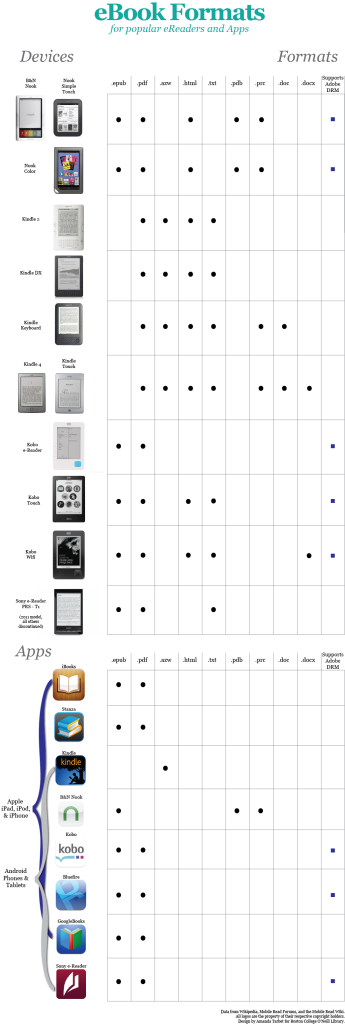
eBooks are normally available in specific formats. The most widely accepted formats are.

EPUB (.epub) format

MOBI (.mobi) format

AZW (.azw) and AZW3(.azw3) format

IBA(.iba) format

PDF(.pdf)

Understanding eBook Formats

  1. EPUB

The most widely adopted eBook file format is EPUB. This was initially conceptualized by the International Digital Publishing Forum (now part of the World Wide Web Consortium), and this format superseded the old Open eBook format (OEB) in 2007.

Because this format EPUB is free to use, open standard, and vendor-independent, it has grown leaps and bounds and has emerged as the most common eBook format. Though not always used, it can even support color images, SVG graphics, interactive elements, and full videos.

This is the eBook equivalent of the trusty MP3-both positively and negatively. Nearly all computer operating systems and mainstream e-readers support this format; however, publishers can also wrap it in any DRM system of their choosing.

And the downside? Amazon Kindle devices- the most popular eBook platform cannot read it (however, the Kindle Fire tablet can read them). If you have a book in the EPUB format that you want to read on your Kindle, the format needs to be changed to make it readable.

  1. MOBI

With EPUB, the MOBI format also grew out of the old OEB format. French company Mobipocket introduced this in 2000 and with time it went on to form the basis of its Mobipocket Reader software.

Amazon bought the company in 2005 and nurtured them to flourish till October 2016, when Amazon finally shut down Mobipocket’s website and servers, but the MOBI format continues to live on.

Of the few key differences between EPUB and MOBI, the most important is it is not an open standard and hence is not publicly available. It also cannot support video or sound.

All major e-readers can read them except the Barnes and Noble Nook.

  1. AZW and AZW3

The two proprietary eBook formats of Amazon are the AZW and AZW3 extensions. AZW started its journey alongside the first Kindle back in 2007. AZW3 is the younger one and started its journey in 2011 when the Kindle Fire reader was released.

Whenever anyone buys or downloads an eBook from Amazon, he receives it on his device in one of the two formats. AZW3 is more advanced than AZW as it supports more styles, fonts, and layouts.

Both formats are extremely like the MOBI format. Likely, Amazon bought Mobipocket with the intention that it could use the underlying technology as the basis for its AZW format. Unlike MOBI, the Amazon formats support both sound and video.

AZW is not as widely supported on e-readers as EPUB and MOBI as it is proprietary. Hence all of Amazon’s Kindle products can read the format, but other popular devices such as the Nook and Kobo e-readers cannot.

Android and iOS can both read AWZ, and it’s also readable on popular eBook management apps like Calibre and Alfa.

  1. IBA

IBA is another common proprietary eBook format and is used for books that are created in Apple’s iBooks Author app.

This format is quite similar to EPUB from the technical angle- though it mostly relies on custom widget code in the Apple Books app for functioning and hence can’t be universally read on all e-readers.

This format is only used for books written in iBooks Author. If someone buys a few best-selling eBooks from the iTunes store, they shall be delivered in the EPUB format (though they will be DRM-restricted).

The iBook format supports video, sound, images, and interactive elements.

  1. PDF

The last and most widely circulated eBook format in circulation is PDF. Because of the format’s wide acceptance about adoption around the web, PDFs are the most popular way of delivering eBooks.

The biggest drawback of this format is the lack of native reflowing. Reflowing is the common terminology to describe when a file can adapt its presentation according to the size of the screen or the settings a user selected.

All the dedicated eBook formats offer reflowing based on the sequence of objects in the content stream. The PDF format can turn the lack of regular reflowing by using tags to define the underlying structure of a document. However, tagged PDFs are still not well supported by eBook readers.

On the positive side, PDF became ISO 32000 back in 2008 and is the second format of the list that’s an open standard.

Difference between eBook formats

Difference between eBook formats

eBook Conversion

An eBook conversion is a process when a hard copy of a book or document is made into a digital format such as HTML, Mobi, PDF, etc. the services in eBook conversions include processes like print to a digital copy, documents, articles, magazines, and so on to eBooks. The latest services include interactive and multimedia elements made mostly for this digital version. The process of eBook conversion is very lengthy and requires attention to detail and skills in digital formatting. The entire process of correctly formatting and organizing the relevant information is inclusive of scanning the hard copy or data source and thereafter converting it into the required digital format.

The process of eBook conversion is very lengthy and requires attention to detail and skills in digital formatting. The entire process of correctly formatting and organizing the relevant information is inclusive of scanning the hard copy or data source and thereafter converting it into the required digital format.

Only high-quality scanners and specific programs are used by professional publishers to make this process more comfortable, but it is time-consuming.

How can eBook Conversion Benefit your Book?

Some people hold more value in reading a physical book, but the more the number of people get adapted to either a paperback or a Kindle, the better for all books and the authors who write them.

This argument also neglects the various accessibility aspects that having a digital copy available provides. If you were to consider every potential consumer, you would need to have printed books, audiobooks, and eBooks. But eBooks allow us to make one version for all users instead of having a print edition, a braille edition, a large print edition, and an audiobook. With eBooks, we can include everyone in our audience in just one format.

Authors, can broaden their reach, increase reader engagement, lower costs, and sell more by converting their books into longer-lasting, updateable eBooks.

Choosing the right eBook format

The first and most important issue for an eBook format is it should offer a good reading experience, in whichever format it is in, should have the support of both publishers and hardware vendors, and be guaranteed to work for the foreseeable future period. Unfortunately, there isn’t one.

However, if one wants to choose the eBook format depending on the device’s compatibility, then for Android, Sony Reader, and Nook (of any type), EPUB is the best. For PC, Mac, iPhone, and iPad- it is wise to choose PDF or EPUB format. And if it is Kindle or Kindle Fire devices, MOBI or PDF are the best options.

eBook formatting

eBook formatting is a standard design process that turns eBooks’ text and images into an attractive layout for readers to enjoy. It is quite like designing and formatting printed books, but here it is focused solely on the books in the digital space.

There are essentially 6 steps in formatting an eBook:

  1. Import the fully edited manuscript.
  2. Format the chapter titles and paragraphs.
  3. Add images, page breaks, and endnotes.
  4. Upload the book cover in the correct size.
  5. Set the table of contents and copyright page.
  6. Export the print and eBook files.


  • Choose a topic that matches your audience’s needs.
  • Outline each chapter of your eBook.
  • Break down each chapter as you write.
  • Design your eBook.
  • Use the right colors.
  • Incorporate visuals.
  • Highlight quotes or stats.
  • Place appropriate calls to action within your eBook
  • Convert it into a PDF.
  • Create a dedicated landing page for your eBook.
  • Promote your eBook and track its success.

And while doing so, always keep in mind:

  1. Stick to the brand guidelines.
  2. Keep the front cover simple, yet eye-catching.
  3. Think about your eBook thumbnail.
  4. Use different font sizes to guide your readers.
  5. Don’t forget the images.
  6. Use custom graphics.
  7. White space is your best friend.
  8. Don’t go too overboard with lots of colors.
  9. Make it sharable.
  10. Make it unique.

Reasons to write a book

In case someone asks the reason for writing a book, my immediate answer shall be I love to share and hence I write. I share my experiences, my knowledge, my feelings, and my world with others. And I shall love to know the same things about others as well. Our world is limited to relatives, friends and acquaintances and we have gained some knowledge about them over the years by direct interactions. However, to know about the world beyond my circle, I read. And I write to reach out to that world. When I read a book, it works as a therapy to me- I get solutions to many problems I face, both internal and external. Similarly, my writings as well as the books of many authors heal others and acts as a therapy. Writing a book involves reading as well- an author reads a lot and educate himself before writing a book. This reading adds on to his wisdom and changes the life of the writer in the days to come.

Writing a book is not limited to better writing skills only. Self-motivation, time management, planning and setting goals are key factors to transpire thoughts and ideas to book. Motivating oneself and managing time from the daily routine to write, planning what to write and setting a time for finishing the book is not as easy as it seems to be. However, if someone wants, he can. Hence all can write books. And when one takes the challenge and writes a book, he would himself see the difference in him before writing and after completing writing the book. This challenge ends with a self- assessment experience as it reveals more about us to ourselves. It is this experience that lets one know the persistence level in oneself and their strengths and weaknesses as well. And the most important aspect is- it manifolds one’s confidence in oneself – as conquering the intellectual challenge is not an easy thing to do at the end of the day! The fact that a person has finally joined the league of interesting story tellers whom he has awed after and adored all his life makes a person feel like reaching the summit of a mountain. And this feeling brings lot of positive changes in life in days to come. Monetizing the knowledge- getting financial benefit from the sharing of knowledge by writing a book is something which one has not witnessed before is an experience by itself!

Financial benefits of writing a book

Writing a book increases the credibility and acceptance of a person as that helps in positioning a person as a thought leader and helps in attaining respect from customers and business associates. If a book is handed over to a person on the other side of the table, it saves time from persuading or explaining him as the book instantly increase credibility. Wiring books can generate fantastic leads for the business as well. Most business authors use the strategy of sending a copy of the book to the target customer and before establishing a contact also, the customer can be reached in the process. And precisely for this purpose, the business authors mention the contact details in the book itself- as they are almost certain that if the book reaches the target customer, building a bridge is just a matter of time- books being the most effective promotional tools. For a business author, it help in getting speaking and consulting assignments and many business authors have developed their careers as public speakers and business consultants through his book. Passive income is a dream of all- writing a book opens up the door of this additional income in form of royalty. And for a business writer, the new leads and referrals is more important than royalty- as they transpire to new customers even if books are distributed strategically.

Importance of publishing industry

Book publishers promote the writers and ensures that their creative skill is brought to the forefront and reaches the mass. They are the mediators in connecting the authors to their target readers. Hence publishing industry is of immense importance and without their support, all the hard-work of the author shall be futile and unnoticed.

Authors need support, reassurance and motivation to deliver their creative best. It is the publisher who imbibes the positivity in the author with his valuable feedbacks. With the feedback from the publisher, the author mends his loopholes and improves in areas which were previously unnoticed by him. At times, the writers become overly cautious and analytical about themselves. It is the publisher who comes as a messiah to them and provide the necessary support, boost and feedback to ensure the author reach the next level. The author may not understand about the commercial angle and is oblivious about ideas to increase the profitability and sale. The publishing house assign the right genre of the book of the book to ensure the commercial success.

Why do people prefer paper books?

The feel of paper makes a huge difference in the mind of the reader. There is a real human experience to holding a book in hand, smelling the paper, hearing the crackle of the binding and flipping through the pages matters a lot. . Observing the number of pages you’ve read and the number you are left to read also plays a part of the psychological experience of reading. Reading a light-emitting e-book before hitting bed hampers the sleep, affect the alertness the next morning with an over-all negative impact on health. The recall value of paper book has been found having more recall value than e-book. A recent survey suggested that over 75% of people between the age group 18 and 24 years had read a paper book in last year. Only 21% had read an e-book. Most importantly, 66% of children between the ages of 6 to 17 preferred print books. Most of the students receiving e-textbooks get the book printed. The primary reason for this is concentration. 92% of the students of an American university researched that 92% of college students concentrate better when they study with paper books.

E-book publishing

E-book is electronic version of printed book.  Over time and advent of newer technologies, e-books have become increasingly popular. The reason for the popularity of e-books are many. They are easy to publish and the process is user-friendly at a reasonably low cost. The reach-out is maximum and there is no cost involved for this reach-out, and generates a passive income for the author. Hence, a huge section of authors are actively publishing e-books leveraging the platform and increasing the earning creating book funnel without any extra effort and building fan base. The steps of publishing an e-book are quite simple. Quite naturally the first condition is one has to write a book which is worthy of printing. Once one has written a book good enough to reach the readers, he also has to ensure the book is well edited and well designed. Thereafter, the author has to write a book description which is essentially telling the readers why this book should be read, what value this book would add and how is it different from the book of other authors. The proverb A book is judged by the cover is more applicable in case of an e-book, hence it is important the author designs an attractive cover for the book. Formatting the e-book for kindle is also extremely important for the success of the book in this version. Next, the author chooses the e-book publishing platform-the most common is Amazon as they sell 60% to 80% of all digital books and Kobo, Google Play, Apple Books are few of the other prominent sellers. Thereafter, the author selects a price for his e-book, create a direct publishing account with the seller and shall upload his book.

Business book

This genre of book writes about running of a business, or financial aspects of a business and of management. Business books include books containing step-by-step instructions on how to run a business and things one should know on how and when to start, own and run a successful business touching all ends of business including marketing, finance, taxes etc. They may also include growth of a business in different cultures and regions and their economic impact on business. Whether it is  a small business owner, entrepreneur, or just someone seeking useful career advice, there are many great books of this genre to look forward to. Business books can provide psychological concepts for better negotiation skills, personal anecdotes to avoid repeating mistakes, or self-help tips to improve productivity.

How to Write a Hyperbole

Hyperbole is a very effective tool for authors as they can elevate the prose with a wide range of diverse phrases and descriptions. They can be written in different ways. The author needs to identify exactly where he wants to use the hyperbole and the context. The easiest one is to write in absolute words like never, always, worst, best, everything, nothing and similar words as they are used in exaggerating the situation described by the author. Another way of writing hyperbole is by stretching the attribute to hyperbolize something funny. A typical example is – the entire city came to know that he fought with his wife. While it implied that the fact that the couple fought is known to many, where hyperbole is created by stretching the information to the entire city. The most acclaimed examples of hyperbole however are those that are written by stretching the intermediate-level ones with a new thing. These are quite similar to similes and metaphors which also follow the same principle to strike a difference. While writing a hyperbole, an author should keep in mind that they are constructed with the purpose of not being taken literally. The boy kicked the ball very high can be replaced with hyperbole and read like the boy kicked the ball so high that it touched the cloud. Also, an author should be cautious that he doesn’t use overused hyperboles. The girl ran faster than lightning is a typical example of this category. An author also has to be cautious that he gets so tempted on using hyperbole that he suppresses important facts.


When to Write a Hyperbole


It is when the author feels that the use of a hyperbole shall add spice to the content and the image or character shall be benefited from the use of one- an author may decide to write a hyperbole. The author first should have clarity on which elements of an image or character is most important and thereafter compile a list of illustrative comparison as a set of tools from which he can choose the best. Hence, ideally, an author should write a hyperbole only when he is fully prepared and confident about using one and knows the hyperbole shall fit into the content naturally and will not look imposing. Normally, an author prefers to use hyperbole when he is writing something humorous or conversational, as its use makes the statement more amusing or dramatic. It is a tool strictly for fiction and non-fictional wrings like songs, essays, poems or stories but not for serious writing. Hence, hyperboles should be avoided if one is writing a research paper or technical writing.


Hyperbole Definition and Examples


  • Hyperbole is a figure of speech that brings you under the spotlight by deliberately exaggerating a part of the statement and has been spicing up the languages for centuries. The word originated from the Greek word ‘huperbolḗ,’ which means ‘to throw beyond’. They are used to add flavour to the writing by highlighting the difference between two things and emphasizing a point.  They are very effective tools for literary writers and can elevate a prose and add a huge diversity of phrases and descriptions. They are rhetorical devices as well as a type of figurative language. Hyperboles are key components in satires- satirists use them to demonstrate the extremities in events and opinions they are trying to focus upon through humour. Shakespeare has used hyperbole many times to bring his words to life. In Romeo and Juliet, Romeo says about Juliet- “the brightness of her cheek would shame those stars”. His contemporary poet John Donne writes in his poem The Sun Rising- “she’s all states, and all princes, I”. in Sanskrit literature, we find Bhatrihari mentions “A man may tear a jewel”. In modern literature, Flannery O’Connor in Parker’s Back- “ The skin on her face was as thin and drawn as tight as the skin of the onion and her eyes were grey and sharp like the points of two picks”. In his Old Times on the Mississippi, Mark Twain dramatizes a feeling of helplessness by writing “I was quaking from head to foot and could have hung my hat on my eyes, they stuck out so far”. To inject sharp humour, one of the most celebrated authors of the last 100 years, Gabriel Garcia Marquez writes in Living to Tell the Tale –“At that time Bogota was a remote, lugubrious city where an insomniac rain had been falling since the beginning of the 16th century”.


What is the Effect of Hyperbole on the Reader?


Hyperboles are taken by the authors as just an exaggeration where the author uses these to emphasise a point. The readers are quite aware of the fact these exaggerations and claims are mentioned to emphasize the traits of the characters and are not to be taken literally. However, few readers consider the written words as gospel truths and there are chances of them getting misled- as they forget the basic meaning of hyperbole being a figure of speech made with extravagant exaggerations only.


Why Use Hyperbole in Writing


  • By using hyperbole, an author can turn a common feeling into something with a lasting impression. It allows an author to present something common more intensely. The use of hyperbole adds contrast as a normal thin Hyperbole is a figure of speech that brings you under the spotlight by deliberately exaggerating a part of the statement. They are used to highlight the difference between two things and to emphasize a point. With help of hyperbole, a normal thing can be described as giving extra stress, which at the end of the day grabs the attention of the reader and makes the literary work a long-lasting effect in the memory. Constant exaggerations may bore the audience- hence hyperboles are the quickest and easiest way to create an unreliable narrator. They are figures of speech that will influence the relationship between the author and the reader.


Relationship between Narrator and Reader


  • The narrator is the person who delivers the story to the reader. He narrates to the reader things that the character is not aware of and could not perceive. The narrator can even break from the present and take the readers to the future to unveil some details or share some backstories. The narrator may narrate the whole story to the reader in first person and events that can be experienced through the mind and emotion of one of the characters. The narrator has the option of telling the reader what the characters are thinking or feeling. A narrator, when narrates in first person at times creates a sense of trust and bonding with the reader and attracts them into the story involving them in the story mentally. If the narrator shares the story considering the reader as a confidant, the reader starts caring more for the protagonist in the story and be a part of his/her struggle.


Screenwriting


  • Screenwriting is the process of writing scripts for the screenplay medium which the audience sees in form of feature films, television productions or participates in form of video games. This is a unique process and different from writing novels, poems, or essays, It involves writing the movements, actions, dialogues and expressions of all the characters in a screenplay. This format is different from the format of authors writing books as this format is for expressing the story visually. All other mediums may include unlimited contextual detail or omniscient perspectives, but screenwriting strictly rely on visual communication- hence, it is extremely important to keep in mind that each action looks as if it has been written.


Screenwriting is primarily of three types


  • Speculative Screenwriting- this is the most common one. They are written independently and not commissioned by a production company or a film studio.
  • Commissioned Screenwriting- in this type, commissioned scripts to involve a hired writer being brought to an established idea to be brought to life.
  • Feature Assignment- they are the most sought after and here, the writer is brought under contract with a production company or a studio for developing and writing the script.